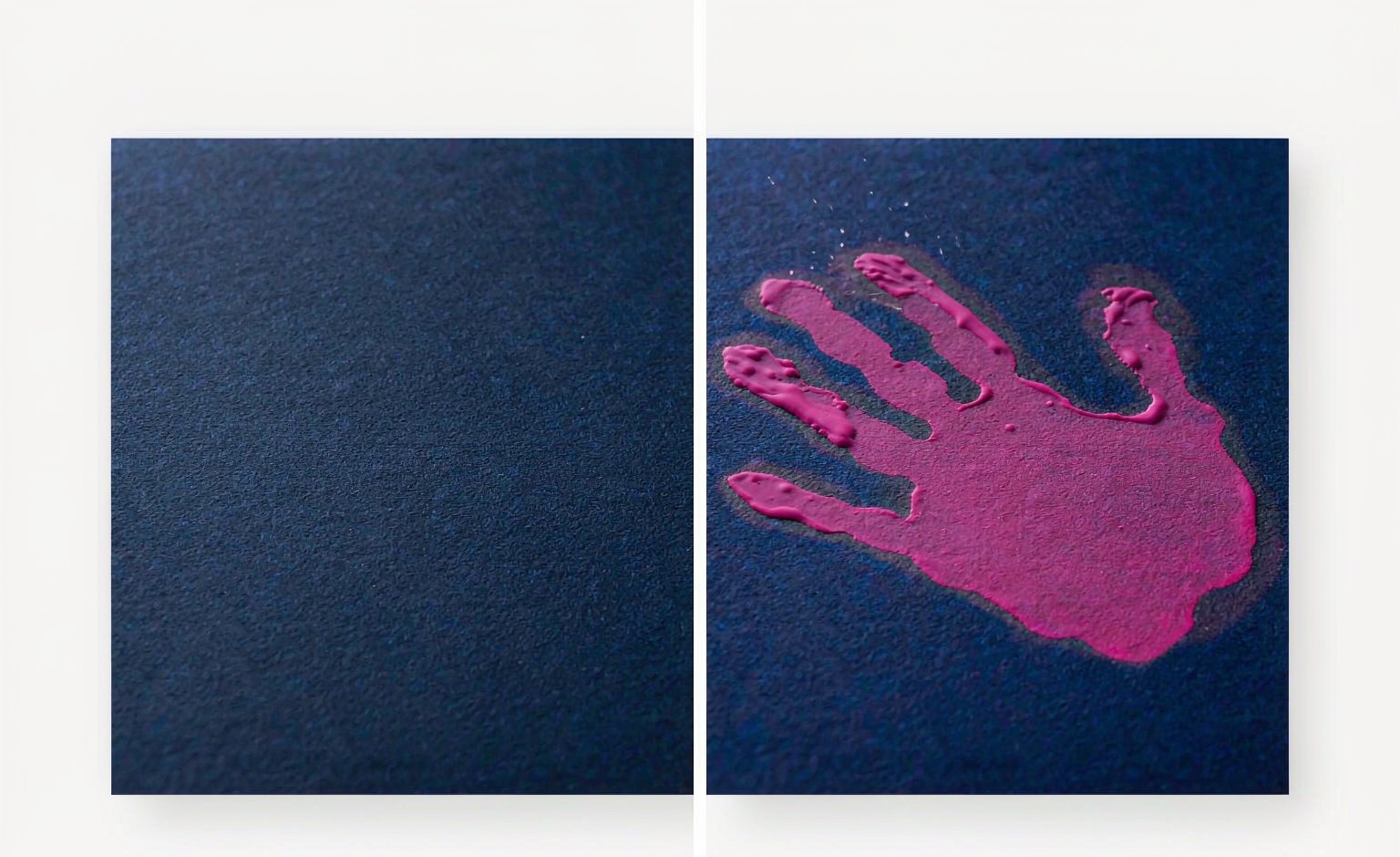
Thermochromic pigment changes colour with temperature because colour-forming dye chemistry is locked inside microscopic polymer capsules. Before anything else, a buyer must answer one question: should the colour change back? Reversible types cycle between coloured and clear as temperature or UV exposure changes; irreversible types change once and never return — a specialty UV-dose indicator class, not a standard catalogue line. Buying the wrong type scraps the batch. This guide explains the mechanism, activation temperatures, screen/flexo mesh matching, wash-fastness reality and the document pack for EU-bound shipments. Our Color Changing Pigment catalogue lists the reversible families referenced below.
As Technical Director at EFFECT-PIGMENT (Hangzhou) Co., Ltd., I recently replied to a purchasing manager at a European ink manufacturer who asked for "permanently colour-changing" photochromic pigment. The most widely commercialised photo- and thermochromic pigments are exactly the opposite: reversible. That one-word difference can scrap an entire print run. This guide first draws the reversible/irreversible boundary clearly, then covers particle size and wash fastness realities in textile inks.
— Steve Chan, Technical Director, EFFECT-PIGMENT (Hangzhou) Co., Ltd.
There are two families of colour-changing pigment, and they solve different problems.
Reversible pigment (the mainstream commercial class) switches between a coloured state and a clear or pale state and switches back, cycle after cycle, as temperature rises and falls — or as UV exposure appears and disappears for photochromic types. This is what fashion prints, mood colours, cold-chain indicators and interactive packaging almost always need.
Irreversible pigment changes colour once, permanently, in response to accumulated energy — typically a defined UV dose. It belongs to specialty UV-dose indication and chemical-specialty applications. It is not part of our standard product line, and a request for it goes through a custom-development evaluation: dose thresholds, wavelength, substrate and process first, feasibility and development conditions after. We do not promise free development in a first letter, and we do not give performance commitments before evaluation.
The boundary matters because the failure mode is silent until it is expensive. A European ink group's purchasing manager — a water-based flexographic ink manufacturer with a multi-country footprint — came to us with a specification for "permanently colour-changing" pigment built around eight UV-dose thresholds ranging from 16.5 to 107.5 MJ/m², for security-style label work. The correct first response was an honest clarification of the reversible boundary, not an order confirmation. That conversation is the reason this guide exists: in colour-changing pigments, the reversible/irreversible question is not a technicality — it is the purchasing decision.
The European ink case is not an outlier. Across our first-round enquiries, colour-changing buyers converge on the same three questions — can it switch back, how long does it last, and will it pass my screen — regardless of company size. An industrial R&D institute in South Korea approached us through the website cart for photochromic samples in three grades, with REACH documentation requested alongside — a research buyer whose first need is the mechanism, documented. A boutique glitter brand in the United States, working in the DIY resin-art space, asked for photochromic and chameleon samples in the same cart — and asked the very same reversible/irreversible question, only in more everyday words. Small order or industrial tender, the physics does not change, and neither does the cost of getting the type wrong.
Commercial reversible thermochromic pigment is a microencapsulated system: the colour-forming components (a leuco dye system) are sealed inside microscopic polymer capsules, typically dispersed into ink or coating bases as a powder or predispersion. The capsule wall is what makes the system durable and processable; the chemistry inside is what makes it switch.
Three parameters define a thermochromic grade:
A practical note for formulators: the colour you see is the capsule system against its background. Thermochromic prints read strongest over white or light bases, or as a printed layer on their own — dark, saturated bases mask the switch.
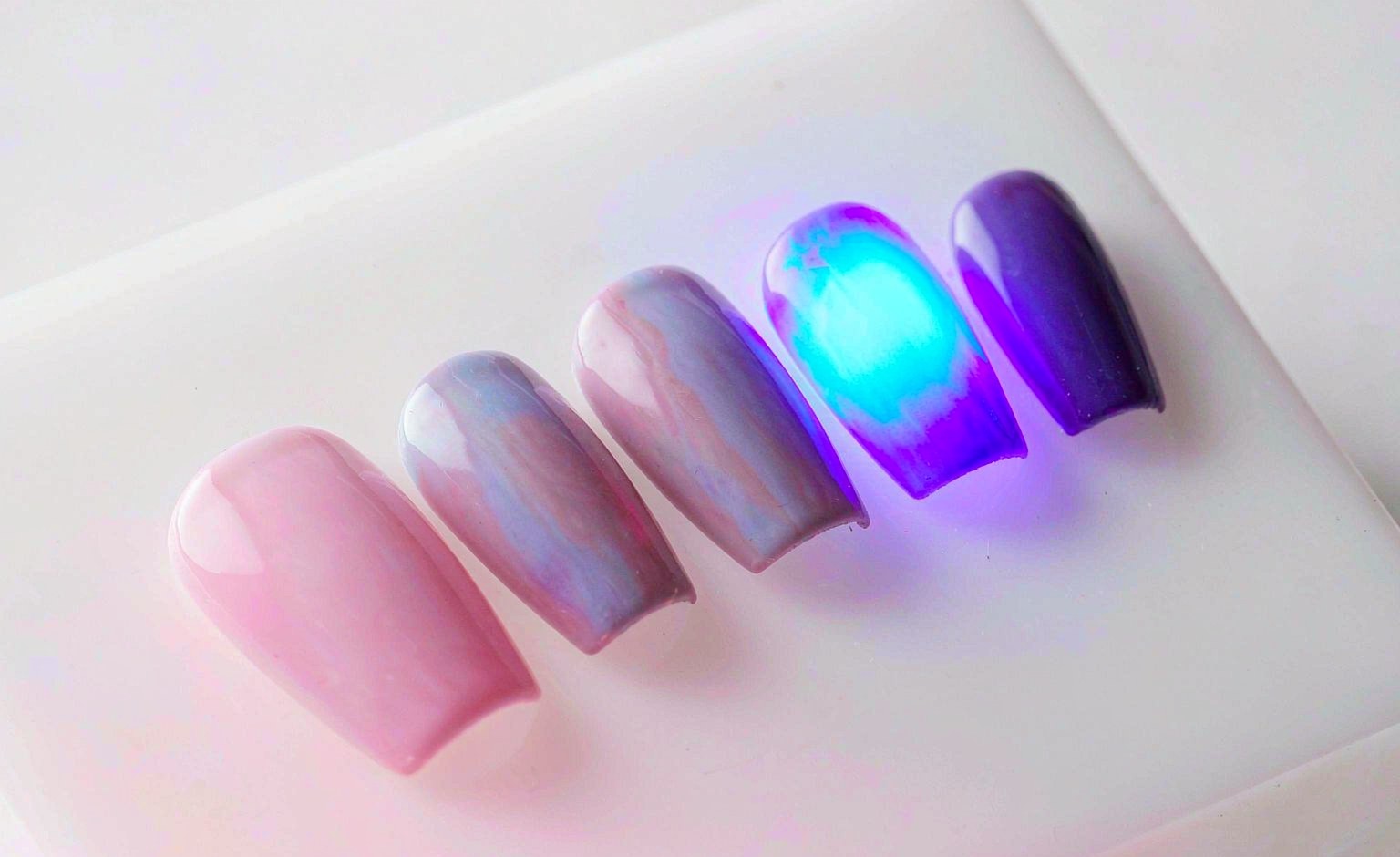
One family distinction belongs here rather than in a footnote. Thermochromic and photochromic pigments share the microcapsule architecture but answer to different triggers: thermochromic grades switch on temperature — body heat, cold drinks, friction; photochromic grades switch on UV exposure — sunlight indoors by a window, outdoor light — and revert when the UV source is gone. Both triggers exist in reversible form, which is why the reversible/irreversible question of the previous section applies to both families. When briefing a supplier, name the trigger scenario ("reveals a message with a cold drink" vs "appears in sunlight") rather than just the pigment class — the trigger decides the grade list, the capsule architecture follows.
Microcapsule particle size must match the printing hardware. The working rule of thumb: the screen opening should be several times the capsule D50. If capsules are comparable in size to the mesh opening, they bridge, clog and starve the print — screen clogging is among the most common process faults in thermochromic textile printing. The same logic applies in flexo: capsule size against anilox cell geometry decides transfer quality.
| Parameter | Rule of thumb | Why |
|---|---|---|
| Screen mesh vs capsule D50 | Opening ≥ several × D50 (exact grade/mesh mapping is confirmed per recommendation) | Capsules larger than the opening bridge and clog |
| Shear during dispersion | Low-shear mixing, post-adding preferred | High shear ruptures capsules; colour switch is lost |
| Ink system | Water-based and plastisol systems both used; binder selection is confirmed per application with our technical team | Binder system governs wash fastness and hand feel |
| Loading ratio | Effect strength tracks loading; the recommended loading range is confirmed per grade on the TDS | Too little reads as weak; too much stiffens the hand |
Two processing notes worth their own lines. First, dispersion kills capsules before heat does: high-shear rotor-stator mixing or triple milling ruptures the polymer wall and the pigment simply stops switching. Post-adding the pigment into a pre-milled base at the final stage is the standard protective practice. Second, the substrate pre-brightens or kills the effect: the switch reads against what is behind it, so a white underbase (or printing the thermochromic layer on its own) is part of the recipe, not an afterthought.
When a printed thermochromic switch reads weakly, the cause is almost always one of three things, and they are worth checking in this order.
If all three are clean and the effect still underperforms, the next check is the activation setpoint itself against the real use temperature — a grade set to switch at a temperature the product never reaches will look like "no effect" even though it is working exactly as specified.
How many wash cycles will it survive? The honest answer is: it depends on three factors, and we do not quote a cycle number without a test report.
Our position is deliberate: no wash-cycle promises without measurement. Life claims come from test reports and TDS statements, and we recommend buyers validate with their own wash standard on their own fabric before committing to end-customer claims. This is not evasion — it is the difference between a marketing number and a number you can defend to your customer.
Sunlight and outdoor exposure. Photochromic and thermochromic systems have a dual relationship with UV: UV is the working medium for photochromic switching, and both families fade under sustained outdoor exposure — this is a characteristic of the chemistry, not a defect. For long-term outdoor use, run a fade-curve sample first. Indoor labels, short-term indication and anti-counterfeiting applications are the stable territory.
For colour-changing pigment going into EU-facing products, the conversation starts with documents, not colour cards:
Our certification posture stays within the site-wide standard: FDA, Kosher, ISO 9001 and GMP workshops are our certified schemes; we do not claim REACH "certification" — REACH is a regulation, and we support it with documentation. See our quality and certification system and our certificates for the full picture, and our blog on EU packaging-era compliance for adjacent reading. For the broader colour-changing family, visit our Chameleon pigment series.
| Term | Meaning |
|---|---|
| thermochromic pigment | A pigment whose colour changes with temperature, built on a microencapsulated leuco-dye system. |
| photochromic pigment | A pigment whose colour changes with UV exposure and reverts when the UV source is gone. |
| reversible / irreversible | Reversible switches back cycle after cycle; irreversible changes once and never returns. |
| microencapsulation | Sealing the colour-forming chemistry inside microscopic polymer capsules for durability and processability. |
| activation temperature | The setpoint at which the colour state switches between coloured and clear. |
| color change cycle | One coloured↔clear switch; the cycle count is a proxy for lifespan. |
| wash fastness | Resistance of the colour change to laundering; depends on capsule quality, binder and wash conditions. |
| light fastness | Resistance of the colour (and effect) to fading under light exposure. |
| UV dose | Accumulated UV energy — the core parameter for irreversible indication (unit MJ/m²). |
| water-based (WB) ink | An ink carried in water rather than solvent; common for textile and flexo printing. |
| flexographic printing | A rotary printing process using an anilox roll to meter ink onto flexible plates. |
| screen mesh count | The number of threads per inch in a screen — matched to the capsule D50 to avoid clogging. |
Q1: Will the colour change back by itself?
It depends on the type, and this is the first question to settle. Reversible pigment — the mainstream commercial class — cycles between coloured and clear as temperature or UV changes and switches back. Irreversible pigment changes once and never returns; it is a specialty UV-dose indicator class, not a standard line. Confirm your application intent before ordering — the wrong type scraps the batch.
Q2: What activation temperatures are available? Can it be customised?
Commercial thermochromic pigments come in series of activation setpoints from low temperatures up to the sixty-plus-degree band, in both heat-to-colour and heat-to-clear orientations, with narrow and wide transition widths. Our specific temperature series and customisation boundaries are confirmed against the current spec sheet — tell us your trigger scenario and we will shortlist grades.
Q3: How many wash cycles can it survive on textiles?
Wash life depends on three factors: microcapsule quality, the binder system, and wash conditions (temperature and mechanical action). We deliberately do not quote a cycle number without a test report — life claims come from measured data and TDS statements. We recommend validating on your own fabric with your own wash standard before making end-customer claims.
Q4: What particle size can pass through my screen or run on flexo?
The rule of thumb is that the screen opening should be several times the capsule D50; capsules comparable to the mesh opening bridge and clog — the most common thermochromic printing fault. In flexo, capsule size against anilox cell geometry decides transfer. We provide grade/mesh matching guidance from the spec library with each recommendation.
Q5: Any compliance or toxicity concerns for EU exports?
We provide TDS, SDS and COA per lot. For EU-facing goods, REACH applies to chemical inputs and downstream product rules apply to the finished article, which belongs to the finished-goods manufacturer. Thermochromic pigments are generally not for food-contact use; cosmetic applications need per-model evaluation — consult our R&D and regulatory contacts before proceeding.
Tell us your trigger scenario — temperature or UV, reversible or indicator — and request thermochromic samples with the full TDS / SDS / COA document pack.