Home/3D Printing
By Application

3D Printing

Effect pigments for FDM filament and SLA/DLP resin — pearlescent, chameleon and metallic grades, matched to your nozzle size and loading.

Last updated: 2026-11-06

Products for 3D Printing

Every series we supply for filament, resin printing and post-print finishing.
3D Printing Selection Guides

Three decisions settle most 3D printing projects: which process, which particle size, and how much to load.

Process

FDM or Resin: Which Pigment Survives Which Process

Inorganic platelets — mica, glass flake, aluminate — tolerate extrusion. Microencapsulated pigments do not: heat and shear rupture the capsule wall. Match the chemistry to the process before you match the colour.

Particle Size

Matching D50 to Nozzle Orifice and Layer Height

Keep the largest platelet under one fifth of the nozzle orifice — platelets bridge the melt channel more readily than spherical fillers. On a 0.4 mm nozzle that means a D50 of 15–20 µm; 30 µm and coarser belongs on a 0.6 or 0.8 mm nozzle. Confirm every figure with a test print on your own hardware.

Loading

Loading Limits Before Layer Adhesion Drops

Platelets are flat and pack densely, so they cut the polymer bridges between layers. Around 3 % in filament and 2 % in resin is the practical ceiling unless you accept a weaker part.

How It Works

Three steps from product list to one quote request.

1

Add Products

Click + Add to Inquiry on any product. Your list collects in the floating cart (bottom-right).

2

Add a Note

Drop quantities, application and target market into the message box — once, for the whole list.

3

Submit on Site

One click opens a short form (name, email, company). Your full product list is attached automatically — no email client needed.

Process Compatibility: What Works and What Does Not

Ten product families against three 3D printing routes. A cross here is a chemistry limit, not a stock problem.

Product FamilyFDM FilamentSLA / DLP ResinPost-Print CoatingWhy
Pearl (natural / synthetic mica)✓✓✓Inorganic platelets, stable well above 200–260 °C extrusion temperature.
Chameleon / optically variable✓✓✓Same inorganic flake. Gives angle-dependent colour from a single nozzle.
Borosilicate glass flake✓✓✓Highest transparency of the pearl family; premium cost.
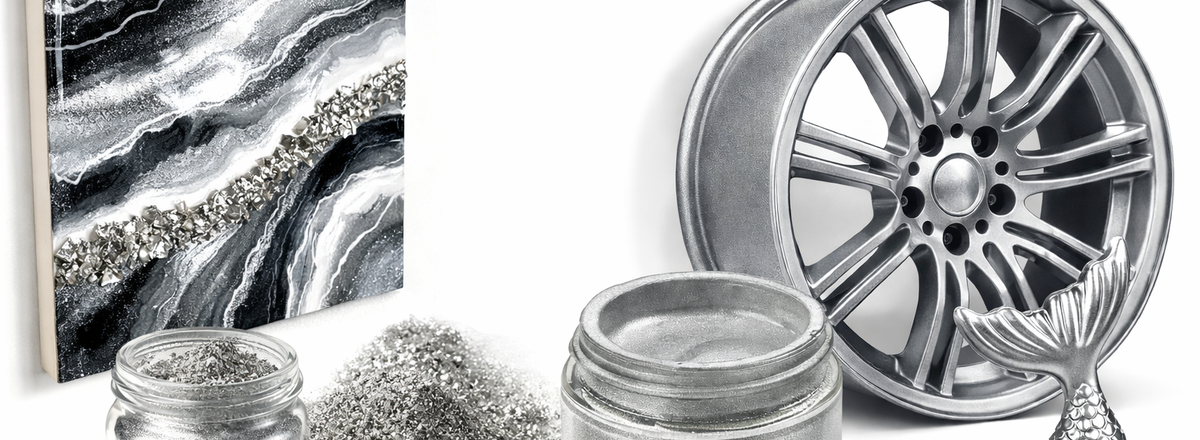
Aluminium powder◐◐✓Usable, but the platelets can make a part conductive — avoid enclosures with electronics.
Bronze powder◐◐✓Tarnishes at melt temperature; expect a darker, warmer tone than the dry powder.
Fluorescent / neon◐ PLA✓✓Organic dyes degrade above roughly 230 °C — PLA is fine, ABS and PC are not.
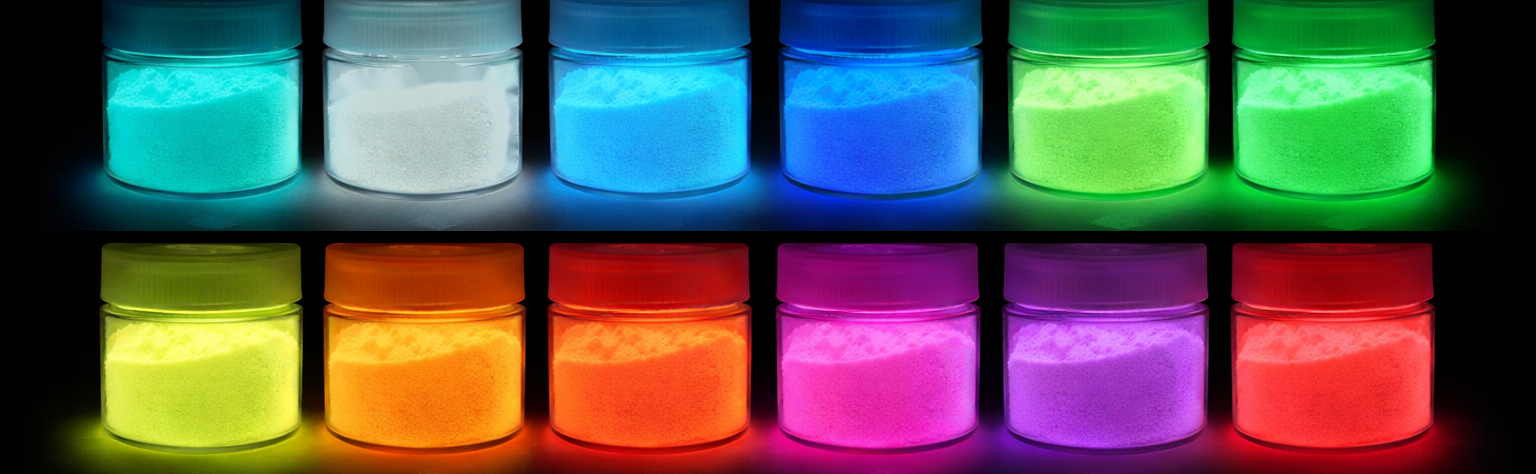
Glow in the dark✓◐✓Heat-stable aluminate. Keep D50 at or below 45 µm so the nozzle does not clog.
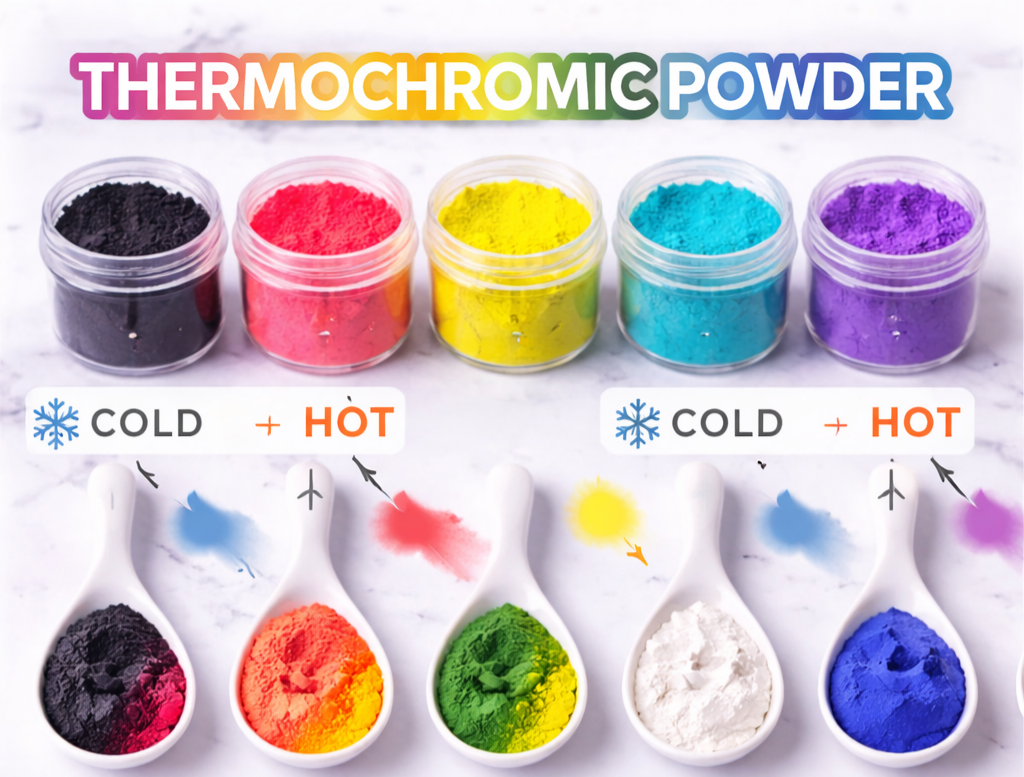
Thermochromic✗◐✓Microcapsules rupture under extrusion heat and shear. Resin or coating only.
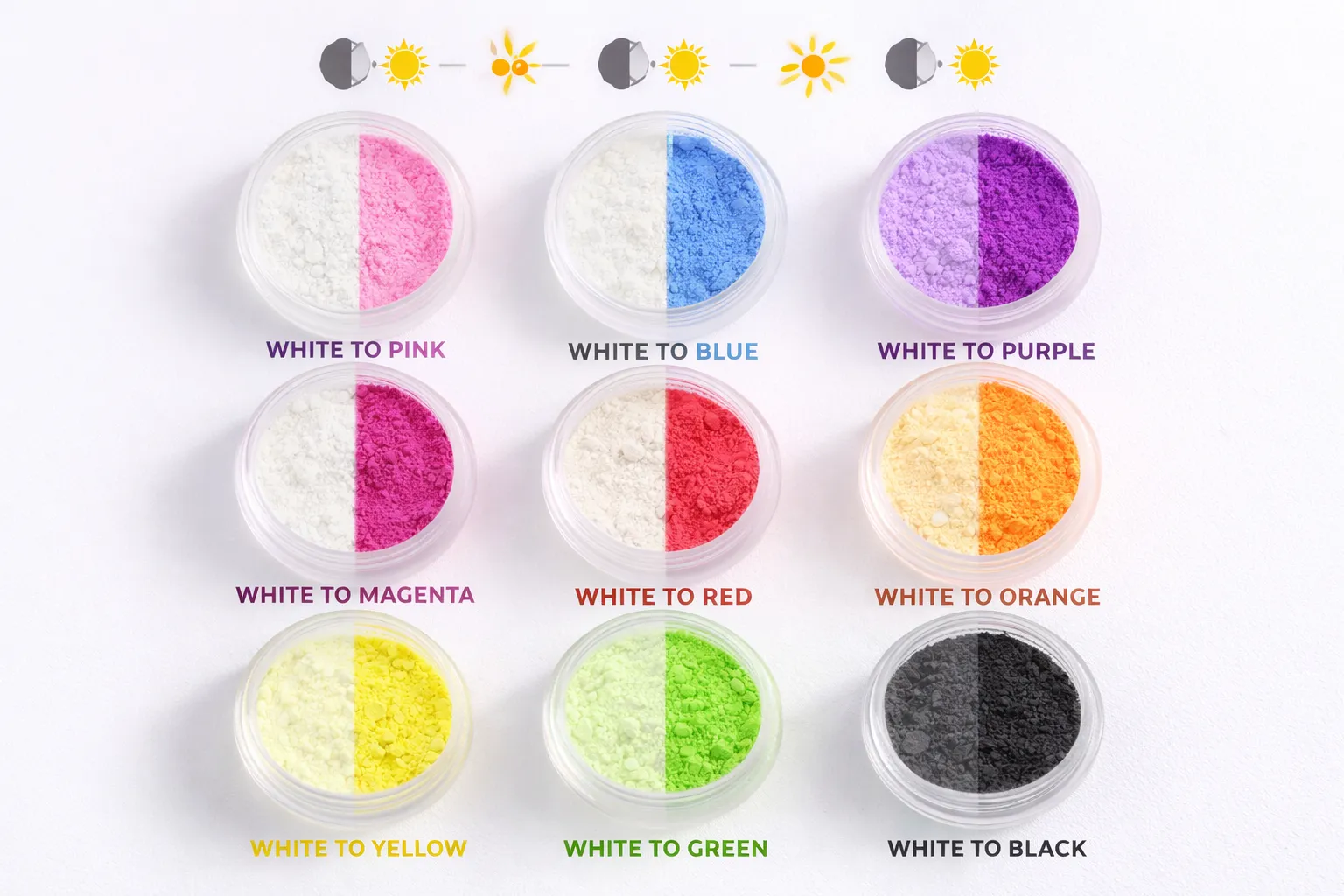
Photochromic✗✗✓405 nm cure light is the pigment's own trigger — parts fade within weeks. Post-print coating only.
PET glitter / flakes✗✗✓PET film softens near extrusion temperature; it clogs the nozzle and smells.
Legend: ✓ recommended, ◐ usable with the stated caveat, ✗ not recommended. The thermochromic and photochromic limitation is physical — if a supplier offers you a heat-sensitive FDM filament, ask for capsule-integrity data before you buy a spool.

Particle Size, Nozzle and Layer Height

Pick the band from your hardware, not from the swatch book. These are starting points — confirm with a small trial.

ProcessCritical DimensionRecommended D50Loading StartNotes
FDM, 0.4 mm nozzle400 µm orifice≤ 15–20 µm1–3 %Largest platelet under one fifth of the orifice (≈ 80 µm).
FDM, 0.6 mm nozzle600 µm orifice≤ 50 µm1–3 %A coarser band buys noticeably stronger sparkle.
FDM, 0.8 mm nozzle800 µm orifice≤ 60 µm1–3 %Maximum flash, at the cost of surface roughness.
SLA / DLP / LCD resin35–50 µm pixel, 25–100 µm layer≤ 25 µm0.5–2 %Platelets scatter UV — raise exposure 10–30 % and stir the vat before each print.
Post-print coating / spray—5–25 or 10–60 µmPer systemThe easiest route and the best control over the final effect.

Print First, Colour After: Post-Print Coating

A third route that bypasses the nozzle and the hot end — and the only dependable one for colour-change chemistry.

This is the route we recommend for any colour-change effect on a printed part: it avoids extrusion heat, extruder shear and cure-light exposure in one move.

Application Decision Guide

Match what you are printing to the series we would send, with the reason behind each choice.

What You Are PrintingRecommended Product / SeriesReason
Colour-shifting filament spoolChameleon / OVP, 15–30 µmSingle-material flip — no dual-extruder or nozzle swap needed.
Satin or silk pearl filamentPearl / Silver-White, 10–25 µmThe fine band hides layer lines better than any coarse grade.
Mirror-metal printed housingAluminium / Metallic Series, 10–20 µmA tight particle size gives a sharp specular reflection instead of a grey cast.
Clear resin with sparkleBorosilicate, 5–20 µmGlass flake keeps transparency where mica would make the part cloudy.
Glow-in-the-dark filamentGlow Powder, 15–45 µmCoarse enough to glow, fine enough to print on a 0.4 mm nozzle.
Heat-indicator or demo partThermochromic in resin or topcoat onlyMicrocapsules survive low-shear resin, not extrusion.
Metal feel without conductivityBronze, 10–25 µmBronze stays far less conductive than aluminium at the same loading.

Loading, Drying and Dispersion

Directional starting points for compounders and print farms — not a fixed formulation.

Frequently Asked Questions

Common questions from buyers about this product. Click to expand answers.

Yes. Mica-based pearl and chameleon grades are inorganic platelets that survive PLA, PETG and ABS extrusion temperatures. Use a fine band — D50 around 10–25 µm — and load 1–3 %.

Keep the largest platelet under one fifth of the orifice and D50 at 15–20 µm on a 0.4 mm nozzle. Above roughly 60 µm D50 the clogging risk rises sharply. Confirm by test print.

No. The microcapsules rupture under extrusion heat and shear, so the colour change stops working. Use thermochromic pigment in SLA/DLP resin or as a post-print coating instead.

Above about 3 % loading in filament, or 2 % in resin, you will measure a drop in impact strength and layer adhesion. Stay at or below those levels and test a coupon before a production run.

Start at 1 % and titrate up. Most pearl and chameleon effects land between 1.5 % and 3 %; aluminium and bronze need less because they hide better.

Partly. Platelets lying parallel to the surface scatter light across the layers, which softens the stair-step look and reduces sanding. It is not a substitute for a smaller layer height.

Borosilicate glass flake keeps the most clarity; synthetic mica is the next best. Natural mica gives a warmer, more opaque pearl.

Aluminium and bronze platelets can make a part conductive enough to matter. Keep them out of enclosures that house PCBs or antennas, or use a mica-based pearl instead.

Yes — free 5–10 g samples ship within 3 working days. Tell us your resin, nozzle size and target loading and we send the matching particle-size band.

Most pearl and metallic grades start at 1 kg; our photochromic and thermochromic grades start at 0.1 kg. Sample packs run 5–10 g and standard packs up to 25 kg.

More from EFFECT-PIGMENT: Pearlescent Pigment Supplier & Manufacturer  ·  Quality Standards & Certifications (FDA / Kosher / ISO 9001 / GMP)

Related technical articles